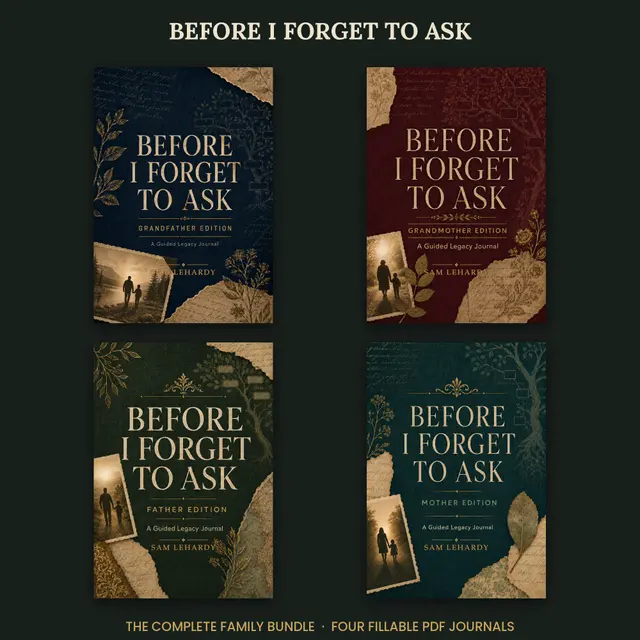
Before I Forget to Ask · An Unhurried Conversation
The Research Behind the Book
Every question in this series stands on published work in family storytelling, life review, and oral-history practice. Here is that work, so you can read it yourself.
The Before I Forget to Ask books were not brainstormed — they were built.
The shape of the questions, the ten-chapter arc of a life, the follow-ups, the
listener's craft, and even the permission to skip anything all come from
several decades of research by psychologists, gerontologists, palliative-care
clinicians, and oral historians. This page collects the sources so that nothing
in the books has to be taken on faith.
01 — Family Stories & Resilience
Why the books ask about roots, hard chapters, and the family's tested moments — not just the highlight reel.
Duke, M. P., Lazarus, A., & Fivush, R. (2008) · Psychotherapy: Theory, Research, Practice, Training, 45(2)
The “Do You Know?” scale: twenty questions of family knowledge whose scores are associated with resilience and well-being in children and teens. Those twenty questions are woven through the opening and family chapters of every volume.
In the booksChapters 1 & 6 · the “oscillating narrative” behind the hard-chapters sections
Elias, A., & Brown, A. D. (2022) · Frontiers in Psychology, 13
A review of the growing evidence that knowing one's family history is associated with positive mental health — and that how stories are told matters as much as whether they are told.
Merrill, N., Booker, J. A., & Fivush, R. (2019) · Topics in Cognitive Science, 11(4)
Young adults retain and retell their parents' stories, drawing insight into the parent, themselves, and the lessons carried — the evidence behind the Father and Mother volumes.
Gardella, J., Parnes, M., Hirst, W., & Brown, A. D. (2021) · Frontiers in Psychology, 12
Knowing the life story of a close elder — family or not — is associated with lower depression. The reason this series explicitly welcomes chosen family.
Weststrate, N. M., McLean, K. C., & Fivush, R. (2024) · Personality and Social Psychology Review
Expands who counts as “family” in the transmission of stories across generations.
In the booksmentors, godparents, and honorary grandparents belong here too
02 — Why the Telling Helps the Teller
Why the books are organized by life theme, why repeated stories are honored, and why it's never too late to start.
Guiding Autobiography Groups for Older Adults: Exploring the Fabric of Life
Birren, J. E., & Deutchman, D. E. (1991) · Johns Hopkins University Press
The guided-autobiography tradition: remembering by life theme rather than by calendar reliably produces richer stories. The source of this series' ten-chapter arc and its specific, scene-first questions.
In the booksthe ten-chapter structure · “describe the kitchen” beats “describe your childhood”
Webster, J. D. (1993) · Journal of Gerontology, 48(5)
The teach/inform mode of reminiscence — telling in order to hand something down — is among the most adaptive, and is the doorway these books use for reluctant storytellers.
In the books“teach me something on this page” · the know-how chapters
The Redemptive Self: Stories Americans Live By
McAdams, D. P. (2006) · Oxford University Press
Redemption sequences — struggle, then what came of it — are the story shape most strongly linked with well-being. The reason the hard chapters always ask what carried the family through.
In the booksthe Hard Roads / Hard Seasons chapters
McColl, M. A. (2022) · Scandinavian Journal of Caring Sciences
A small interview study (13 storytellers, 126 stories) in which aging parents returned again and again to roughly ten stories, most from their teens and twenties — repetition as transmission of identity and values, not decline. A compelling organizing idea, and the source of the books' Ten Stories page.
In the booksThe Ten Stories · “never rush a story you've heard before”
Chochinov, H. M., et al. (2005) · Journal of Clinical Oncology, 23(24)
A structured clinical protocol of legacy questions — proudest moments, lessons learned, words that must not go unsaid. Early studies reported that many patients found it deeply meaningful and families treasured the documents; later randomized trials found more modest measurable effects. The books borrow the questions, not the therapy: their closing chapters are a family-table cousin of this protocol, asked years earlier.
In the booksthe legacy chapters · the guidance for families with little time
03 — The Oral-History Craft
Where the interviewing method, the recording guidance, and the ethics of sharing come from.
The ethics beneath the books' sharing pages: the storyteller's ownership of their own story, informed consent for recording, and honoring restrictions on use.
In the booksWho May Share This · recording with a per-session yes
If your storyteller served in uniform, the Veterans History Project accepts qualifying interviews — eligibility, release forms, and length requirements apply; their site has the full kit. The American Folklife Center and the Vermont Folklife Center's field guides informed the practical technique for non-professionals.
The model behind the books' equal-voices rule — for every ten stories they give you, tell one of your own — and the mail-in mode for far-flung families.
In the booksNow Ask Me Anything · the long-distance conversation plan